
After the Water Falls: Why Shoreline Erosion Threatens Northern Michigan’s Lakes
Spring flooding left northern Michigan lake shorelines eroding and ecosystems at risk. See how TrapBag erosion barriers hold soil in place and protect water.
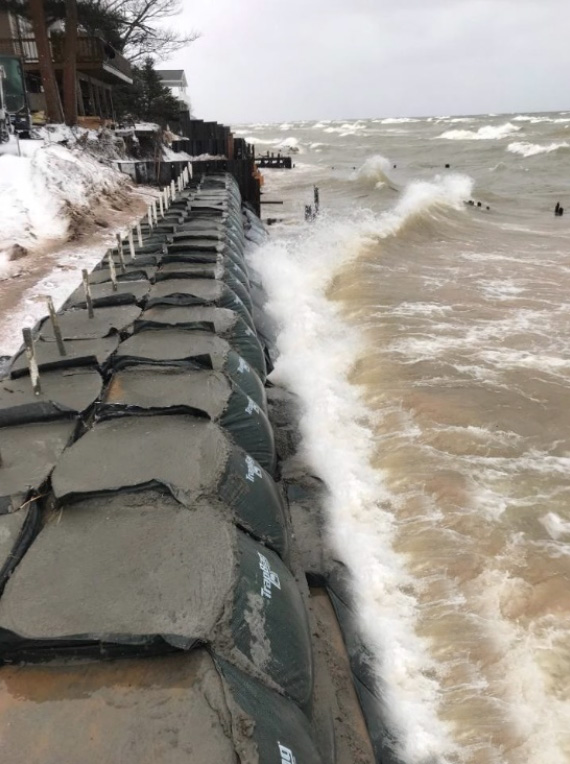
This spring, heavy flooding pushed water levels across northern Michigan well past where they sit in a normal season. In the Cheboygan River Watershed, lakes like Mullett Lake rose more than a foot above last year’s mark, and the floodwaters did more than fill basements and close boat launches. They reshaped the shoreline itself.
When water rises and then pulls back, it carries soil with it. Banks that held firm for decades slump into the lake. The ground that once anchored grass, trees, and dock footings ends up suspended in the water or settled across the lakebed. For the families, marinas, and townships that live and work along these shores, the damage shows the moment the water drops. The deeper problem is the one you cannot see right away.
Erosion Does Not Stop When the Flood Ends
A flood is a single event. Erosion is what follows, and it can run for months. Every storm that rolls across an exposed bank takes a little more of it. Wave action from boat wakes speeds the process along, which is part of why county officials across the region have asked boaters to slow down and keep their wakes small while shorelines recover.
For property owners and the municipalities responsible for public launches and parks, that leaves a short window. Stabilize the bank before the next round of weather, or watch the loss compound storm after storm.
Why Eroded Shorelines Put Ecosystems at Risk
Soil washing into a lake is not only a property problem. It is an ecological one.
The dirt that erodes off a bank carries nutrients, mostly nitrogen and phosphorus, into the water. Those nutrients feed algae and aquatic weeds, which grow fast and thick once fed. As that overgrowth dies off and breaks down, it pulls oxygen out of the water. Fish, insects, and the other animals that depend on dissolved oxygen are the ones that pay for it. Biologists call this process eutrophication, and once a lake tips into it, recovery is slow and far from guaranteed.
This is why preservation groups and watershed councils across northern Michigan are watching their lakes closely after this season’s flooding. A single high-water year can deposit enough sediment to shift the balance of a watershed for a long time. The shoreline is the first line of defense, and when it erodes, the whole system downstream feels it.
The Economic Cost Lands Fast
The ecological damage takes time to measure. The financial damage does not.
Marinas along the Indian River and waterways like it have struggled to open for the boating season because the shorelines they normally anchor docks and hoists to have washed away. High water keeps installers from working, and one good storm can scatter whatever does get put in. For a seasonal business, a lost spring is a lost year. The same erosion that threatens fish habitat also threatens the local economy built around the water.
Where TrapBag Holds the Line
TrapBag was built for this situation: holding soil in place when water wants to move it.
A TrapBag erosion barrier is a series of connected, sloped cells that crews fill with sand or local material to form a continuous wall along a bank or shoreline. Once filled, the barrier takes on wave energy, blocks the soil behind it from sliding into the water, and gives an eroded bank a stable face to rebuild against. Because the cells link together and follow the contour of the land, the barrier works along irregular shorelines, around launches, and across the uneven terrain that watershed edges tend to have.
For a lakefront community, that does two jobs at once. It protects the bank, the dock footings, and the property behind them. And by keeping soil out of the water, it protects the lake from the nutrient load that feeds algae and starves fish of oxygen. Shoreline protection and ecosystem protection turn out to be the same job.
TrapBag also installs faster than poured concrete or hauled-in riprap, and it can be placed ahead of the next storm rather than months after the fact. For municipalities and agencies, it is available through TrapBag’s GSA Multiple Award Schedule listing, which covers erosion barriers alongside flood barriers and cofferdams.
Protecting the Watershed Starts at the Water’s Edge
Northern Michigan’s lakes are still settling after this spring. Water levels are easing, but the exposed banks left behind stay vulnerable to every storm between now and freeze-up. The communities, marinas, and conservation groups that depend on these waters have a narrow season to stabilize what the flood loosened.
Holding the shoreline in place is how you protect both the property and the ecosystem behind it. That is the work TrapBag was made for.
Talk to the TrapBag team about shoreline and erosion barriers for your community or property.
Meet the author

Kevin Vigne
Kevin Vigne is Sales Director at TrapBag®, where he connects customers with the right barrier systems for their projects. He’s often the first point of contact, helping agencies and organizations simplify the process of flood protection, erosion control, and more.
Get the Dirt Before the Flood Hits
Stay ahead of flooding, erosion, and disaster response challenges. The Dirt, TrapBag’s monthly newsletter, delivers field-tested tips, real-world case studies, and the latest in barrier technology straight to your inbox.