

Commercial Flood Protection for Facilities & Industrial Sites
Facility managers at plants, warehouses, utilities, and commercial campuses use TrapBag® to keep floodwater away from buildings, equipment, and inventory. A three-person crew can build a barrier around the whole site in hours instead of protecting one door at a time.
How Facility Managers Use TrapBag
TrapBag protects commercial and industrial sites before, during, and after floods and storms.
Perimeter Flood Protection
Floodwater that reaches a facility can short out electrical rooms, ruin inventory, and stop production for weeks. TrapBag forms a continuous wall around buildings, loading docks, equipment yards, and parking, so water stays outside the site instead of being stopped at each door.
Hurricane & Storm Surge Prep
Coastal facilities have a few days of warning before a hurricane makes landfall. Crews place TrapBag around buildings and outdoor equipment ahead of the storm and leave it in place until the surge recedes.
Spill & Secondary Containment
Fuel tanks, chemical storage, and process areas need a way to hold a spill on site. TrapBag forms containment berms that keep fuel and chemicals out of storm drains and nearby waterways.



Where Facility Managers Use TrapBag
Commercial and industrial sites use TrapBag wherever floodwater or spills threaten operations.
Manufacturing plants
Barriers keep water off production floors, machinery, and raw material storage.
Warehouses and distribution centers
Perimeter walls protect loading docks, truck courts, and inventory.
Water and wastewater treatment plants
Barriers protect pumps, electrical gear, and treatment basins so service continues through a flood.
Substations and utility sites
TrapBag works as a flood barrier for critical infrastructure such as substations, switchyards, and backup generators.
Office parks and retail centers
Flood protection for commercial buildings keeps water out of lobbies, storefronts, and underground parking.
Doors and openings
For individual doors and loading docks, many facilities pair the perimeter with aluminum flood planks or water-filled barriers.

How TrapBag Improves on Sandbag Barriers
TrapBag was originally designed as a flood barrier that could withstand hurricane-force storm surges. Facilities adopted it because sandbagging a large site pulls staff away from shutting down and protecting equipment. Compared to sandbags:
Less labor
A sandbag wall around a plant or warehouse can take a large crew days to build. Two people and a third person operating a skid steer or excavator can fill a TrapBag barrier with sand or washed gravel in a few hours.
More durability
A sandbag wall is only as good as its stacking, and a poorly stacked wall is more likely to collapse in the middle of a flood. TrapBag’s cells are connected and work as one unit, so the barrier holds its shape under water pressure.
Less material
A 100-foot section of 4-ft TrapBag replaces roughly 8,000 sandbags and uses 40% less fill than a stacked sandbag wall of the same size.
Why Choose TrapBags as Flood Prevention Barriers?
Versatility
One TrapBag system handles commercial flood control, storm surge, spill containment, and stormwater detention ponds, so a facility can stock one product for several risks.
Speed
TrapBag goes up in a fraction of the time a sandbag wall takes. A crew of three with a skid steer or excavator can build a full barrier in hours, and folded units can sit on pallets at the facility until a flood warning comes.
Reliability
The U.S. Army Corps of Engineers has tested TrapBag for its ability to protect structures from flood damage. TrapBag also has a 3:1 (mass to hydraulic load) safety factor, which gives facility managers margin above the expected flood level.
TrapBag Specifications for Commercial & Industrial Facilities
Use these figures to scope quantities, draft specifications, and compare bids. Contact TrapBag for spec sheets and submittal documents.
| Specification | Detail |
|---|---|
| Section Length | 50 linear feet per unit; ships folded on pallets and connects end to end |
| Heights | 2 ft and 4 ft; a 2-ft row on a 4-ft row reaches 6 ft; a three-row pyramid reaches 8 ft |
| Sand or gravel fill | Perimeter barriers, spill berms, and stormwater ponds; three people with an excavator or skid steer |
| Concrete fill | Permanent walls; pumped into the cells |
| Sandbag equivalent | 100 ft of 4-ft TrapBag replaces about 8,000 sandbags and uses 40% less fill |
| Testing | Tested by the U.S. Army Corps of Engineers |
| Storage | Folds flat on pallets and stores on site until needed |
| Installation | TrapBag Installation Manual (PDF) |
How TrapBags Compare
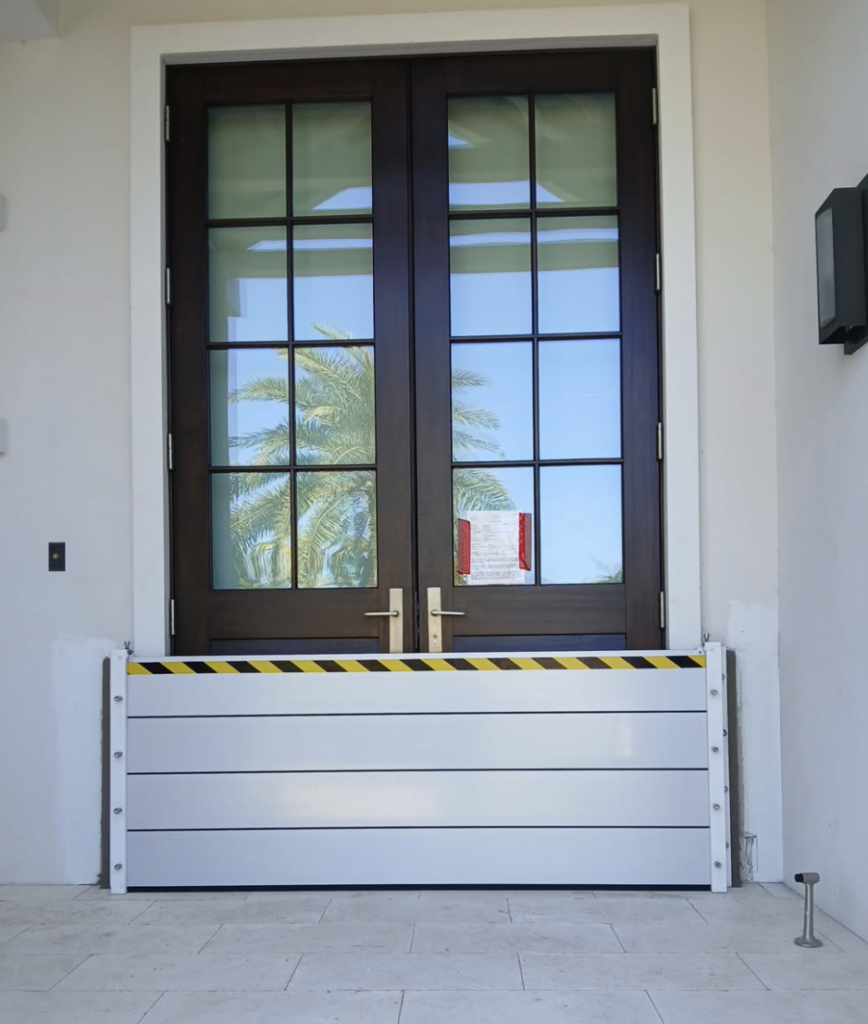
Door & Opening Barriers
Aluminum planks and door dams seal individual doors, storefronts, and loading docks, and they go up quickly once the mounting channels are installed.
They protect one opening at a time, though. Water can still reach equipment yards, parking, transformers, and utility connections outside the building.
TrapBag protects the whole perimeter, and many facilities use opening barriers as a second line behind it.
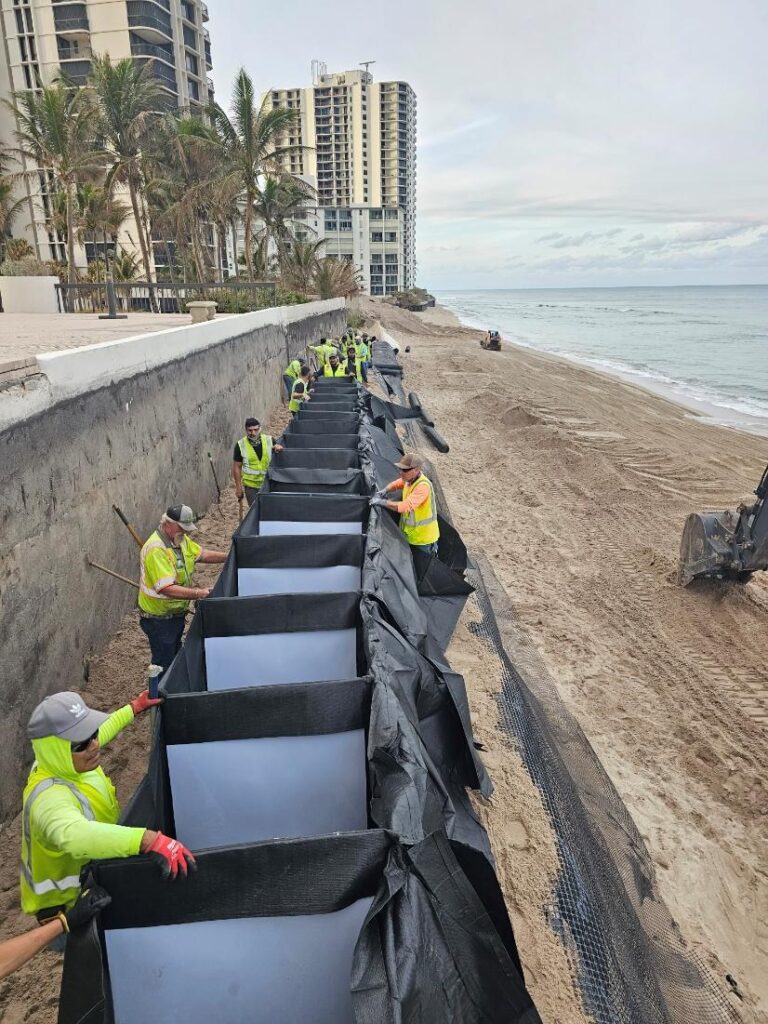
Water-Filled Barriers
Water-filled barriers fill from a hydrant on site, so there’s no sand to haul, and crews can drain and reuse them.
Floodwater carries debris, and industrial yards are full of pallets, steel, and equipment edges that can puncture a water-filled barrier. One hole can drain a section.
Each TrapBag cell is self-contained and filled with sand or gravel, so a damaged cell leaves the rest of the wall standing without the drain-out risk of a water-filled barrier.

Permanent Floodwalls
A permanent concrete floodwall protects a facility around the clock with nothing to deploy.
It also takes engineering, permits, and a construction budget, and it can block truck access, drainage, and future expansion.
TrapBag protects the site while a permanent wall is planned, or only during flood season, and with pumped concrete, it can become a permanent wall itself.
Projects
See All Our Past Projects »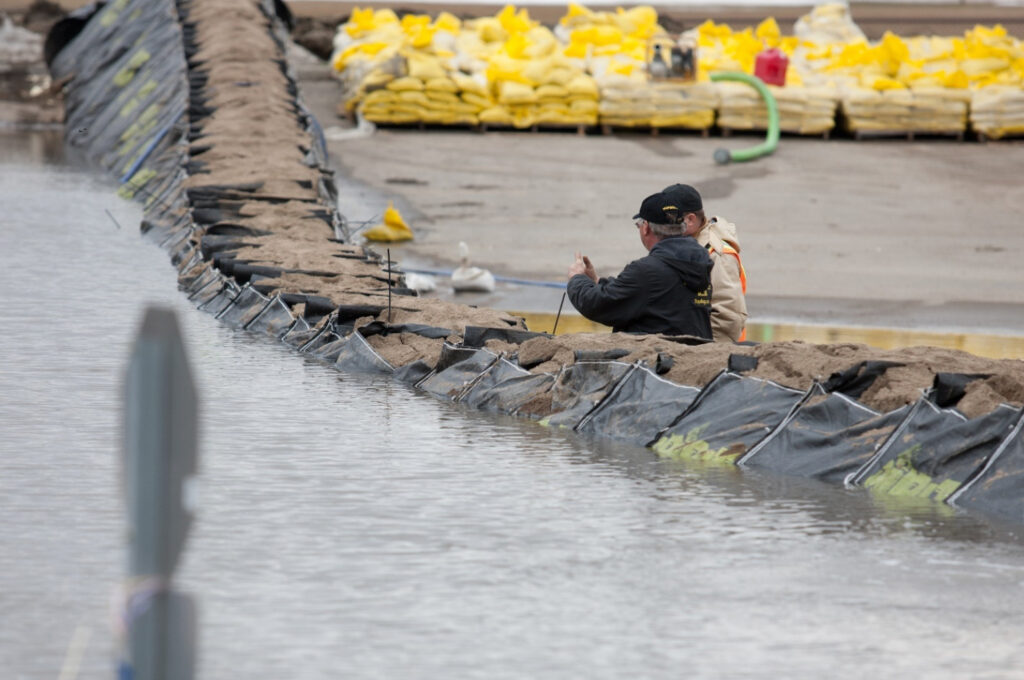
Flood Protection in Fargo, North Dakota
January 24, 2012 Read More » about Flood Protection in Fargo, North Dakota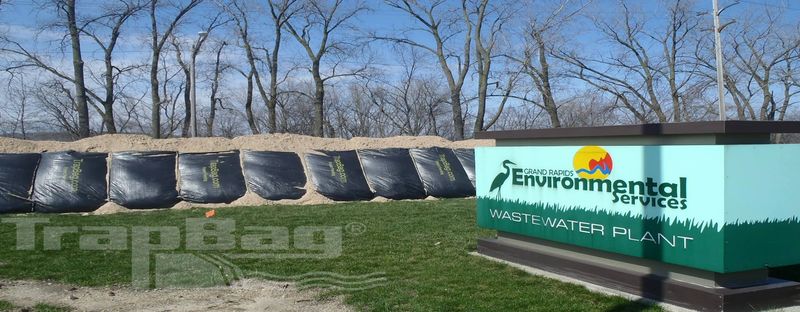
Flood Protection in Grand Rapids, Michigan
May 7, 2020 Read More » about Flood Protection in Grand Rapids, Michigan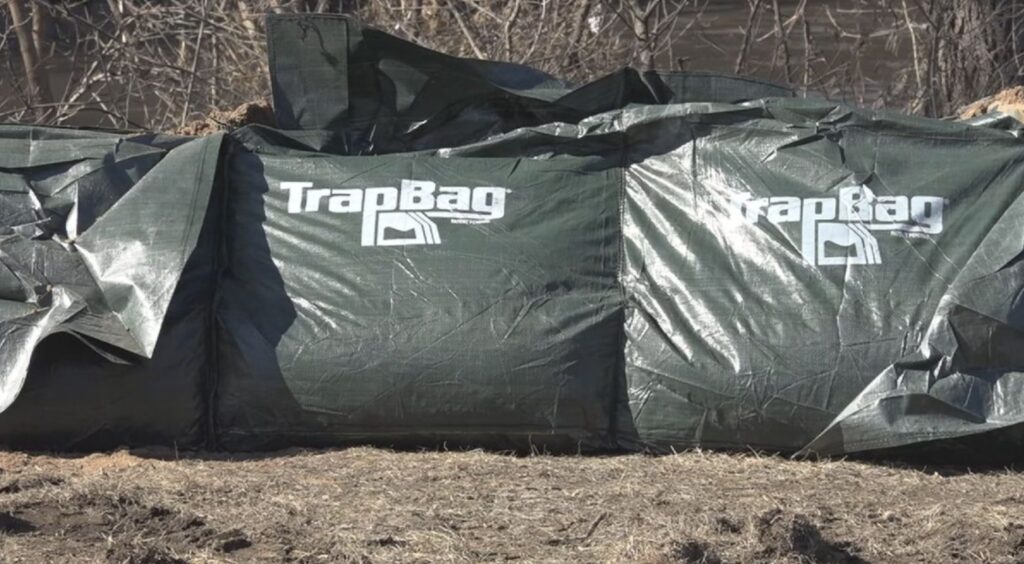
Flood Protection in Sioux Falls, SD
March 21, 2019 Read More » about Flood Protection in Sioux Falls, SD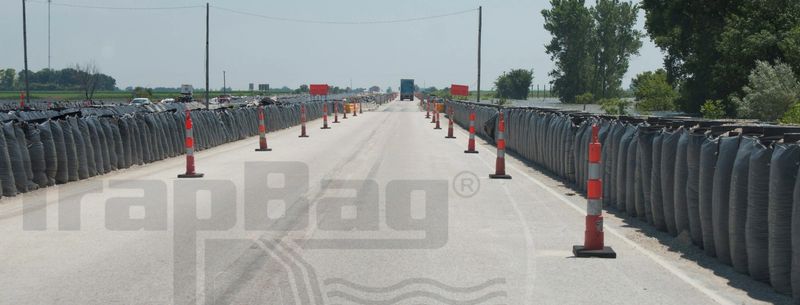
Frequently Asked Questions
Commercial flood protection covers the barriers, building changes, and plans a business uses to keep floodwater away from its buildings, equipment, and inventory. Options range from permanent floodwalls and raised equipment to temporary perimeter barriers like TrapBag and door barriers at individual openings. Most facilities use a mix, matched to how much warning they get and how high water can rise on their site.
Commercial flood prevention starts with a site assessment: where water comes from, how high it can rise, and what it would damage first. From there, facilities raise electrical gear and critical equipment, install backflow valves and sump pumps, plan where barriers go, and train staff to deploy them. A written flood plan lists who does what and when to start.
The best commercial flood protection systems protect the whole site, not only the building. Perimeter barriers like TrapBag keep water out of yards, docks, and parking as well as the building itself. Door and opening barriers add a second line at entrances, and permanent floodwalls make sense where flooding is frequent and the budget allows. The right mix depends on flood depth, warning time, and how much of the site needs protection.
Manufacturing plants protect against flooding by keeping water away from production equipment, electrical rooms, and raw materials. That means a perimeter barrier around the plant, raised or sealed electrical gear, and a shutdown plan that starts before water arrives. Barriers around chemical storage also keep floodwater from spreading spills across the site.
Water and wastewater treatment plants protect against flooding by raising pumps and electrical equipment, building berms or floodwalls around the site, and keeping backup power above flood level. During a flood, crews add temporary barriers to close gaps and protect basins and buildings the permanent system doesn’t cover, so the plant keeps running when the community needs it most.
Yes. TrapBag fills with a skid steer, excavator, or front-end loader, plus a crew of three. Facilities without their own equipment can rent it locally, and TrapBag can recommend a layout so the rental and fill delivery are lined up before a flood warning.
The U.S. Army Corps of Engineers has tested TrapBag as a flood barrier.
How Do I Get a Flood Protection Quote for an Industrial Facility?
Send TrapBag a site plan or aerial image with the area you need to protect marked, the flood height you expect, the fill and equipment available on site, and your delivery location. TrapBag will send back a recommended layout, unit count, and pricing.