
Flood Barriers for Garage Doors
What Works, What Leaks, and How to Cover the Widest Opening on Your Property A garage door is usually the widest opening on a building and the closest one to grade. When water rises, it gets there first, and it brings whatever is stored inside into the loss column: vehicles, tools, inventory, the water heater in the corner. Garage doors are built to keep out weather, not standing water. The bottom seal is designed to shed rain, not hold a head of it. Panels flex under pressure, and side jambs let water run straight through even when the door itself…
What Works, What Leaks, and How to Cover the Widest Opening on Your Property
A garage door is usually the widest opening on a building and the closest one to grade. When water rises, it gets there first, and it brings whatever is stored inside into the loss column: vehicles, tools, inventory, the water heater in the corner.
Garage doors are built to keep out weather, not standing water. The bottom seal is designed to shed rain, not hold a head of it. Panels flex under pressure, and side jambs let water run straight through even when the door itself is intact.
Two systems can hold water back at a garage opening. They work differently, and the right one depends on how often you flood and how much warning you get
Why Sandbags Fall Short at a Garage Door
Sandbags are the default because they are available at the last minute. They are also the worst fit for the opening they are most often used on.
A double garage door is 16 feet wide. Covering that span takes roughly 100 to 150 sandbags, filled and hauled and stacked by hand, usually in the rain. Water finds the seams between them. The pile absorbs water rather than blocking it, and afterward the bags are wet, contaminated, and expensive to dispose of.
They work once. Then you do it again next season.
Option 1: Aluminum Plank Flood Barrier Systems
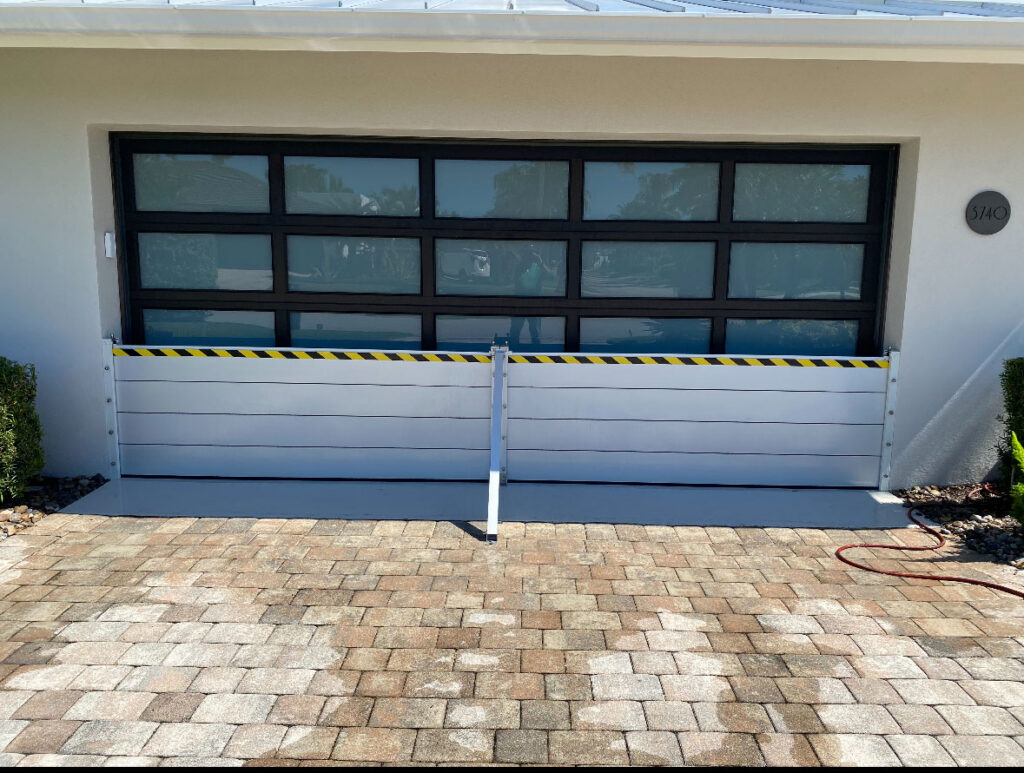
The TrapBag® Aluminum Plank System is a permanent installation engineered for a single opening. Side channels mount to the jambs and stay there year-round. When a storm is forecast, structural aluminum planks stack into those channels and compress against seals to form a solid wall. After the water drops, the planks come out and the door operates normally.
Because each system is engineered around the measured width, height, and structural conditions of the opening, it fits oversized residential doors, roll-up commercial doors, and loading bays. Protection height depends on those measurements rather than a fixed product spec.
What it does well:
- Holds a straight, sealed line across wide openings
- Stores in a small footprint between events
- Corrosion-resistant aluminum built for repeat seasonal use
- Integrates with perimeter TrapBag® barriers for layered protection
The tradeoff is that installation happens once, in advance. This is the system for an opening you expect to protect every season, not something you buy the week of a hurricane.
For residential installations, TrapBag® partners with Emerald Green for installation, seasonal removal, and pre-storm readiness management.
Option 2: Water-Filled Barriers
When a flash flood warning gives you an hour, deployment speed decides the outcome. TrapBag® Water-Filled Barriers are modular 54-inch units that fill with water on site and connect end to end. A standard 16-foot garage door is covered by a continuous line rather than a stack of bags with gaps between them.
Each unit holds back up to 16 inches (0.4 m) of water when installed correctly. Empty, the units are light enough for one person to carry and fold flat for storage on a garage shelf.
What it does well:
- Deploys in minutes with no permanent installation
- Moves between openings as conditions change
- Replaceable bladders when a unit needs refreshing
- Built for static or low-velocity floodwater
Sealing the liner properly during setup is what determines performance. Run through it once on a dry Saturday. The first time you deploy should not be at 2 a.m. with water in the driveway.
Which One Fits Your Property
The choice usually comes down to how often you flood and whether the opening is fixed.
Attached residential garages. Water follows the driveway down to the door and pools against the bottom seal. Water-Filled Barriers handle most residential events. If the opening floods more than once a season, the plank system stops being the expensive option.
Waterfront and coastal homes. Storm surge arrives with force and stays for hours. Aluminum planks seal the garage while perimeter barriers keep surface flow off the foundation. Install the channels once and stack planks each time a storm is forecast.
Warehouses and loading docks. Roll-up doors and ground-level bays give floodwater a wide path to stored goods and equipment. The plank system spans large openings, and operations teams can stage water-filled units near vulnerable bays as soon as weather turns.
Parking structures. Below-grade parking fills fast, and a flooded ramp puts the whole structure out of service. Plank barriers at the entrance hold back rising water, though drainage capacity underneath determines how long that protection buys you.
Municipal and fire station bays. Apparatus bays cannot be out of service during a flood event. Crews can deploy and reuse both systems each season, and TrapBag is listed on GSA Advantage under contract 47QSMS26D0024, which streamlines procurement for public agencies.
What a Garage Barrier Will Not Do
Both systems are built for static or low-velocity floodwater: storm surge, flash flooding, seasonal water rise. Neither is designed for fast-moving water, river diversion, or permanent dam work. For those conditions, TrapBag’s engineered barrier systems are the better fit.
A barrier at the door also does nothing about water coming up through a floor drain or seeping through foundation walls. Sealing the opening is one part of a broader plan that includes grading, drainage, and elevated mechanicals. Our guide on how to flood-proof a house walks through the rest.
Getting Ahead of the Season
Measure the opening before you need to. Width, height, and the surface condition of the driveway apron all affect which system fits and how well it seals. Then stage whatever you buy where you can reach it in the dark, and inspect seals and channels at the start of each storm season.
Questions?
Not sure which system fits your garage?
Contact our team to discuss door dimensions, expected water height, and driveway conditions. We can help you determine the right configuration for your property.
Frequently Asked Questions
How do I stop water from coming in under my garage door?
Two systems handle it. Water-Filled Barriers fill on site and line up across the opening in minutes, holding back up to 16 inches of water. The Aluminum Plank System mounts side channels to the jambs once, then structural planks stack in whenever a storm is forecast. Both cover the full width of the door, which is where sandbags tend to leak at the seams.
Are garage door flood barriers better than sandbags?
They hold a straighter line, go up faster, and come back down without cleanup. Sandbags need filling, hauling, and stacking, and afterward they are wet, contaminated, and costly to dispose of. TrapBag barriers empty out, fold or stack flat, and store until the next event.
How much water can these barriers hold back?
Each Water-Filled Barrier unit holds back up to 16 inches (0.4 m) when installed correctly. The Aluminum Plank System is engineered per opening, so protection height depends on door width, expected water level, and structural conditions at the property. Both are built for static or low-velocity floodwater.
Will these fit a two-car or oversized garage door?
Yes. Water-Filled Barriers connect in 54-inch modules, so you add units until the span is covered. The Aluminum Plank System is engineered to the measured width and height of the opening, including wide roll-up and commercial doors.
Can I install a garage flood barrier myself?
Water-Filled Barriers can be deployed by your own team, and sealing the liner properly during setup determines how well they perform. For the Aluminum Plank System on residential properties, TrapBag partners with Emerald Green for installation, seasonal removal, and pre-storm readiness.
Do the barriers damage the garage door or driveway?
No. Water-Filled Barriers sit on the surface in front of the opening and leave nothing behind. The Aluminum Plank System uses side channels anchored to the jambs, which stay in place year-round and sit flush enough that the door operates normally between storms.
Will these work in fast-moving water?
No. Both systems are built for static or low-velocity flooding around a property. For high-velocity water, river diversion, or permanent dam work, TrapBag’s engineered barrier systems are the better fit.
Tell Us About Your Project
We are happy to answer your questions and help you find the right setup for your situation. For immediate assistance, please call (239) 674-6611. We are available 24/7.
Get the Dirt Before the Flood Hits
Stay ahead of flooding, erosion, and disaster response challenges. The Dirt, TrapBag’s monthly newsletter, delivers field-tested tips, real-world case studies, and the latest in barrier technology straight to your inbox.