
AquaDam vs TrapBag: Which Flood Barrier Protects Better?
Compare AquaDam and TrapBag for flood control and cofferdam work on deploy speed, fill, strength, and cost, and see why TrapBag holds the line.
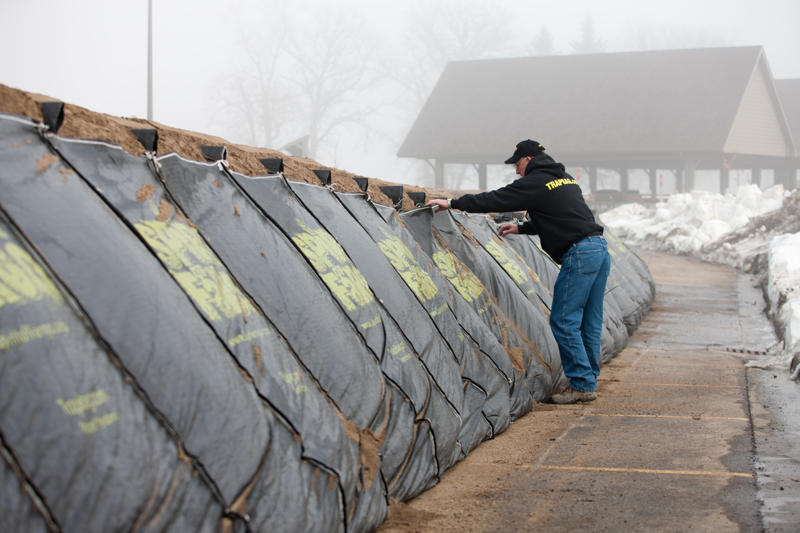
When floodwater is on its way, or when you need to wall off a river to work in the dry, the barrier you pick decides how much of your site stays dry. AquaDam and TrapBag are two of the most common choices for temporary flood control and cofferdam work, and on the surface they look alike: both build a long protective line, both go up fast, and both cost less than an army of sandbags. The difference shows up in how they hold, what they need to deploy, and how long they last. Here is how the two compare, and where TrapBag pulls ahead.
What Is an AquaDam?
An AquaDam is a water-filled barrier, and one of the original water-filled cofferdams. It uses two watertight inner tubes held inside a woven outer sleeve, with a baffle in the middle that keeps the barrier from rolling once it fills. Crews pump onsite water into the tubes until the barrier reaches height, and the weight of that water holds the line in place. AquaDams range from about one foot tall to twenty-eight feet for custom builds, connect end to end with coupling collars for long runs, and conform to uneven ground for a seal.
How AquaDams Control Flooding
Because an AquaDam holds back water using water, it can hold back flood depth up to roughly three-quarters of its own height, and more in some models. Crews roll out the flat barrier along the line they want to protect, then pump water in to fill it, usually two pumps and two people for a residential job. Filling and setting takes anywhere from one to eight hours for most jobs, and longer for the tallest dams. Removal means pumping the water back out and draining the tubes before the barrier can be rolled up. It works for dewatering, cofferdams, and perimeter protection around homes, substations, and treatment plants.
The AquaDam depends on that fill step and on the water staying sealed inside its tubes. It holds nothing back until there is water to pump and the tubes are full.
What Are TrapBags?
TrapBags are cellular barriers built from a row of connected pentagon-shaped cells, each with one sloped side and one vertical side for added strength. They arrive folded on pallets, pull open like an accordion to fifty feet per section, and connect end to end for any length you need. Instead of water, crews fill them with sand, gravel, or concrete using an excavator or skid steer. Standard barriers start at two and four feet tall and stack in a pyramid for heights up to eight feet and beyond.
How TrapBags Control Flooding
A three-person crew with a loader can fill one hundred feet of four-foot TrapBags in about thirty minutes, and that same section replaces roughly eight thousand sandbags while using about forty percent less fill material than a stacked sandbag wall. The connected cells share load, so the barrier holds as one structure rather than a stack of loose bags. The U.S. Army Corps of Engineers has tested TrapBag against severe wave action, and because the cells can be filled with concrete, a TrapBag line can serve as a temporary wall for a season or a permanent gravity wall for years.
TrapBags also go up before the water arrives. Because the barrier gets its mass from solid fill, crews can build the line with material already on site rather than waiting on floodwater to do the work.
AquaDam vs TrapBag: Side-by-Side Comparison
The table below lines up the two barriers on the points that matter most when floodwater is coming.
Where TrapBag Pulls Ahead of the AquaDam
Mass From Solid Fill, Sourced on Site
An AquaDam gets its mass from pumped water, so it cannot hold anything back until crews have a water source and pumps to fill the tubes, and it reaches full height only once those tubes are full. A TrapBag barrier gets its mass from solid fill, including sand, gravel, or dirt already on site, so a crew can build the line from local material ahead of the storm. Water is sometimes pumped into the cells as they fill to compact the material, but the barrier does not depend on a standing water source to hold.
Faster to Full Protection
Thirty minutes per hundred feet of four-foot barrier beats one to eight hours of filling, and the gap grows on longer runs. In an emergency, the hours you save on setup are the hours that keep water out of the building.
Solid Fill, Not a Sealed Bladder
An AquaDam holds its shape only as long as the water stays sealed inside its tubes. TrapBag cells are packed with solid material, so the barrier keeps its shape and its line even if the outer shell takes a hit from debris. There is no bladder to keep pressurized and no water to lose.
Temporary Today, Permanent Tomorrow
An AquaDam is built to come back out. When a TrapBag line is filled with concrete, it becomes a gravity wall that can stand for years, which makes it a fit for shoreline stabilization, erosion control, and long-term levee work as well as short-term flood defense. One product covers the emergency and the rebuild that follows.
Lower Total Cost
Both barriers beat sandbags on labor. A TrapBag barrier draws its mass from fill that is often already on site, which cuts the hauling and water handling that a water-filled barrier depends on, and the option to leave the barrier in place means you may not pay to remove and replace it next season.
Cofferdams: AquaDam vs TrapBag
Cofferdams are where these two products go head to head most often. A cofferdam is a temporary enclosure that walls off part of a river, lake, or shoreline so the water inside can be pumped out, leaving a dry space to build or repair.
AquaDam built its name here as one of the original water-filled cofferdams. It fills with the water already on site, reaches heights up to twenty-eight feet, connects into long runs, and conforms to an uneven river bottom for a seal. For very tall or very long temporary diversions where the water is right there to pump, it is a capable option.
TrapBag competes with a cofferdam built for stability. Its cofferdam configuration uses rectangular, no-slope cells with rigid panels in every wall, set flush in a continuous row with an HDPE liner along the water-facing side for a watertight seal. Crews fill each cell with gravel or local aggregate using the fill, lift, and place method, then work against a firm, straight wall instead of a rounded tube. Because the fill is solid, the wall keeps its shape and its footing even if the liner or shell is nicked, and there is no bladder to hold pressurized while a crew works below the waterline. It costs less than steel sheet pile, fills from material on site, and empties and redeploys across projects.
For contractors who want a stable, workable barrier that holds a straight line and reuses job after job, TrapBag is the stronger cofferdam. AquaDam fits the jobs that call for extreme height or length and a fast fill straight from the water on site.
Which Barrier Should You Choose?
For most flood, erosion, and cofferdam work, TrapBag gives you faster setup on a dry site, a solid fill that does not depend on a sealed bladder, a firm working wall, and the option to make the barrier permanent. AquaDam fits the tall or long temporary diversions where onsite water fill is the priority and the barrier has to come out clean afterward.
TrapBag also gives you a choice AquaDam does not. Alongside the cellular barrier, the Home Defense line includes a water-filled barrier built for smaller openings like doors, garages, and storefronts, so you can match the barrier to the job instead of forcing one product to cover every situation. For emergency managers, public works crews, and contractors who need a line up now and holding, TrapBag is the stronger call.
Protect Your Site with TrapBag
Whether you are bracing for a hurricane, holding back a rising river, or walling off a work site to build in the dry, TrapBag deploys in minutes and holds when it counts. Contact TrapBag to talk through your project and get a quote. Our team is available 24/7 at (239) 674-6611.
Meet the author

Everett “Buzz” Waid
Everett “Buzz” Waid is the inventor of TrapBag® and owner of the company. After witnessing the devastation of Hurricane Charley in 2004, he designed TrapBag® to deliver faster, more effective flood and erosion protection. With a background in engineering and construction, Buzz continues to lead product development and innovation, while remaining closely connected to field operations worldwide.
Get the Dirt Before the Flood Hits
Stay ahead of flooding, erosion, and disaster response challenges. The Dirt, TrapBag’s monthly newsletter, delivers field-tested tips, real-world case studies, and the latest in barrier technology straight to your inbox.