

Municipal Flood Protection Systems for Cities & Government Agencies
Cities, counties, public works departments, and state agencies use TrapBag® to protect streets, public buildings, transit, and water systems from river floods and storm surge. Federal, state, local, and tribal agencies can buy TrapBag through GSA Schedule contract 47QSMS26D0024.
How Municipalities Use TrapBag
TrapBag protects public property during planned projects and emergencies.
Flood Control
When a river forecast calls for a crest above flood stage, public works crews have days, sometimes hours, to protect low-lying streets and neighborhoods. TrapBag goes up as a temporary levee, dike, or flood wall along riverfronts and low streets, then comes down once the water drops.
Hurricane & Storm Surge Protection
Coastal cities in Florida and along the Gulf and Atlantic coasts face storm surge every hurricane season. Crews place TrapBag along low streets, causeways, and public facilities ahead of landfall and keep it in place through recovery.
Stormwater Management
Heavy rain can overwhelm storm sewers and send polluted runoff into rivers and lakes. TrapBag forms temporary or permanent detention ponds that hold stormwater until the system can handle it or crews can treat it.



Where Municipalities Use TrapBag
Cities and agencies use TrapBag wherever floodwater threatens public property or the services residents depend on.
Downtowns and riverfronts
Temporary flood walls protect businesses and public buildings during river floods, as in Grand Rapids, Michigan.
Levees and floodwalls
TrapBag raises levee crowns and closes low spots when a crest threatens to overtop them, as in Fargo, North Dakota.
Highways and roads
Barriers keep floodwater off major routes, as on I-29 in Iowa.
Transit stations and rail yards
Perimeter barriers hold floodwater back from station entrances, bus depots, and track.
Water and wastewater plants
Barriers protect treatment plants and lift stations so residents keep clean water and working sewers.
Parks and public grounds
TrapBag retaining walls hold eroding slopes along roads, trails, and riverbanks.
Hillside neighborhoods
Barriers divert mudflows away from homes and streets after wildfires.
Spill response
TrapBag berms contain chemical spills before they reach storm drains.

How TrapBag Improves on Sandbag Barriers
TrapBag was originally designed as a flood barrier that could withstand hurricane-force storm surges. Cities adopted it because sandbagging pulls public works staff and volunteers away from everything else a flood demands. Compared to sandbags:
Less labor
A sandbag wall along a riverfront can take hundreds of volunteers days to build. Two people and a third person operating a skid steer or excavator can fill a TrapBag barrier with sand or washed gravel in a few hours.
More durability
A sandbag wall is only as good as its stacking, and a poorly stacked wall is more likely to collapse in the middle of a flood. TrapBag’s cells are connected and work as one unit, so the barrier holds its shape under water pressure.
Less material
A 100-foot section of 4-ft TrapBag replaces roughly 8,000 sandbags and uses 40% less fill than a stacked sandbag wall of the same size.
Why Choose TrapBags as Flood Prevention Barriers?
Versatility
One TrapBag system covers river floods, storm surge, stormwater ponds, retaining walls, and spill response, so a public works department can stock one product for several hazards.
Speed
TrapBag goes up in a fraction of the time a sandbag wall takes. A crew of three with a skid steer or excavator can build a full barrier in hours, so the city can wait for the forecast crest before committing crews.
Reliability
The U.S. Army Corps of Engineers has tested TrapBag for its ability to protect structures from flood damage. TrapBag also has a 3:1 (mass to hydraulic load) safety factor, which gives cities margin above the forecast crest.
TrapBag Specifications for Municipal Projects
Use these figures to scope quantities, draft specifications, and compare bids. Contact TrapBag for spec sheets and submittal documents.
| Specification | Detail |
|---|---|
| Section Length | 50 linear feet per unit; ships folded on pallets and connects end to end |
| Heights | 2 ft and 4 ft; a 2-ft row on a 4-ft row reaches 6 ft; a three-row pyramid reaches 8 ft |
| Sand or gravel fill | Flood fights, levee raises, and stormwater ponds; three people with an excavator or skid steer |
| Concrete fill | Permanent walls; pumped into the cells |
| Sandbag equivalent | 100 ft of 4-ft TrapBag replaces about 8,000 sandbags and uses 40% less fill |
| Testing | Tested by the U.S. Army Corps of Engineers |
| GSA Schedule | Contract 47QSMS26D0024: flood barriers (TBR/RFB), erosion barriers (TBRD), and cofferdams (TBRCD120); see GSA purchasing |
| Installation | TrapBag Installation Manual (PDF) |
How TrapBags Compare

Permanent Floodwalls & Levees
Permanent floodwalls and levees protect a city for decades without crews having to set anything up before a flood.
They also take years of design, permitting, and funding, and a project can cost tens of millions of dollars.
Many cities still have low spots and unprotected neighborhoods while they wait. TrapBag protects those areas now, and with pumped concrete, it can become a permanent wall.
Demountable Flood Walls
Demountable flood walls use aluminum panels that crews slide into posts before a flood, and they come down afterward with no trace on the street.
The posts and foundations have to be installed in advance, so demountable walls only protect the openings a city planned for.
TrapBag needs no foundation, goes down on streets, parking lots, and grass, and can stack higher if the forecast crest rises.
Water-Filled Barriers
Water-filled barriers fill from a hydrant, so there’s no sand to haul, and crews can drain and reuse them.
River floods carry logs, debris, and vehicles, and one puncture can drain a section of a water-filled barrier.
Unlike a water-filled barrier, TrapBag cells are self-contained and filled with sand or gravel, so damage to one cell leaves the rest of the wall standing.
Projects
See All Our Past Projects »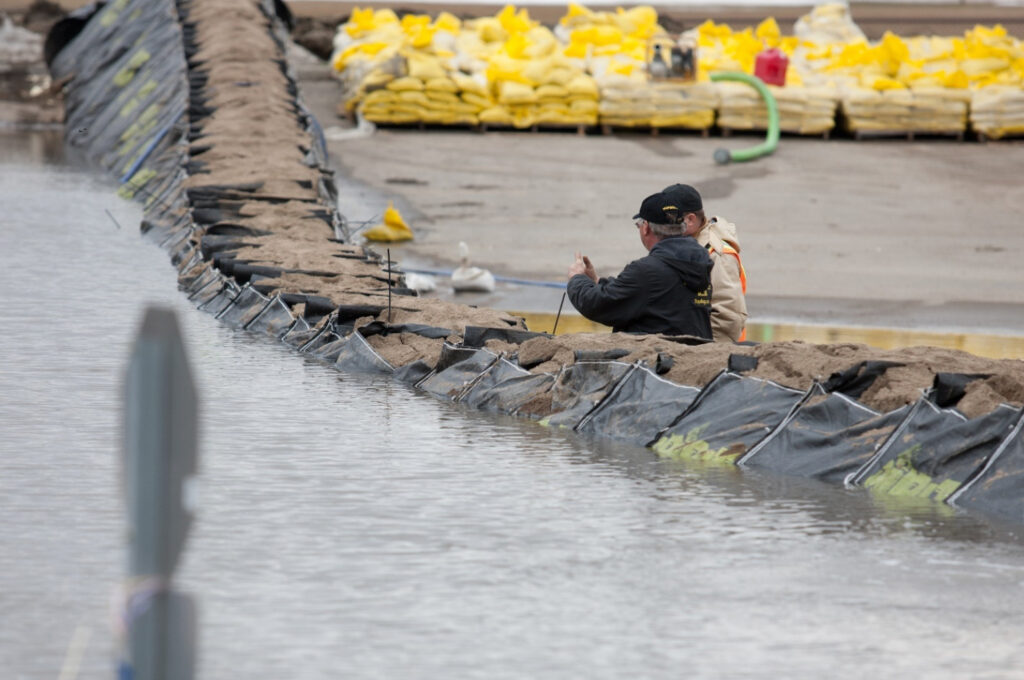
Flood Protection in Fargo, North Dakota
January 24, 2012 Read More » about Flood Protection in Fargo, North Dakota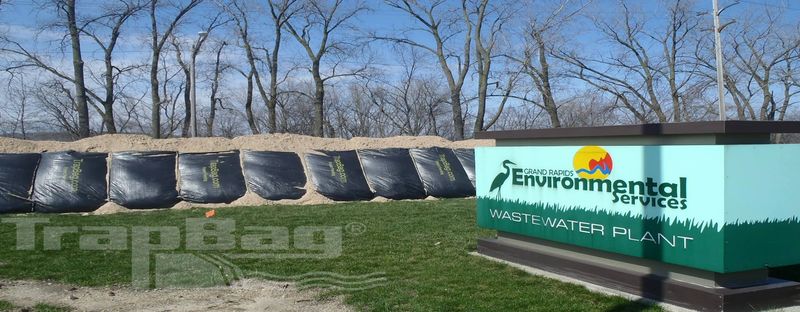
Flood Protection in Grand Rapids, Michigan
May 7, 2020 Read More » about Flood Protection in Grand Rapids, Michigan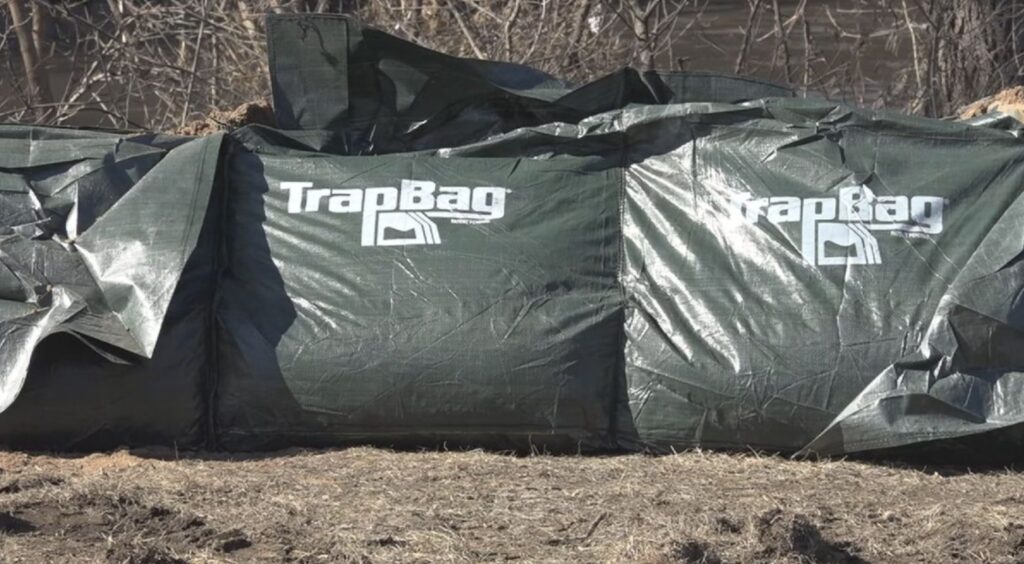
Flood Protection in Sioux Falls, SD
March 21, 2019 Read More » about Flood Protection in Sioux Falls, SD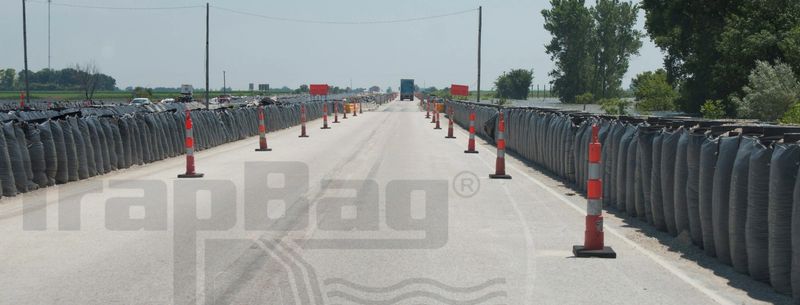
Frequently Asked Questions
Municipal flood protection systems are the barriers, drainage, and plans a city uses to keep floodwater away from homes, businesses, and public property. Permanent systems include levees, floodwalls, pump stations, and storm sewers. Temporary systems, such as sandbags, water-filled barriers, and fillable barriers like TrapBag, close gaps and protect areas the permanent system doesn’t reach. Most cities rely on a mix of both.
The best flood protection for a municipality depends on how much warning it gets, how high water rises, and how many people it can put on a barrier. River cities with a few days of warning can build temporary levees along forecast flood zones. Coastal cities need barriers that can take wave action from storm surge. Cities with little warning need barriers that a small crew can build in hours, with fill stockpiled ahead of time.
Cities protect transit stations by raising entrances and vents above flood level, installing floodgates and deployable covers at openings, and pumping water out of tunnels. Before a storm, crews also place temporary barriers around station entrances, bus depots, and rail yards to keep floodwater from reaching the openings. TrapBag works as that outer perimeter.
Yes. Federal, state, local, and tribal agencies can buy TrapBag flood barriers, erosion barriers, and cofferdams through GSA Multiple Award Schedule contract 47QSMS26D0024 at pre-negotiated prices. Visit our GSA purchasing page for product listings and ordering steps.
FEMA’s Public Assistance program can reimburse eligible emergency protective measures, such as temporary flood barriers, after a disaster declaration, and FEMA and state hazard mitigation grants can fund flood protection projects. Eligibility depends on the program and the declaration, so check with your state emergency management office before purchasing.
Yes. Filled with sand or gravel, TrapBag can stay in place through a flood season or a construction project. With pumped concrete, it becomes a permanent wall, and TrapBag’s Fabric Forming Systems are designed for permanent concrete flood walls.
The U.S. Army Corps of Engineers has tested TrapBag as a flood barrier.
What Information Does TrapBag Need for a Quote?
Send the length of the area you need to protect, the target height or forecast crest, fill material available locally, whether you’ll buy through GSA, and the delivery location. TrapBag will send back a recommended layout, unit count, and pricing.