
Temporary vs. Permanent Levee Systems
Learn the difference between a temporary levee system and a permanent levee system, and the impact they have as a flood water barrier.
What Is a Levee?
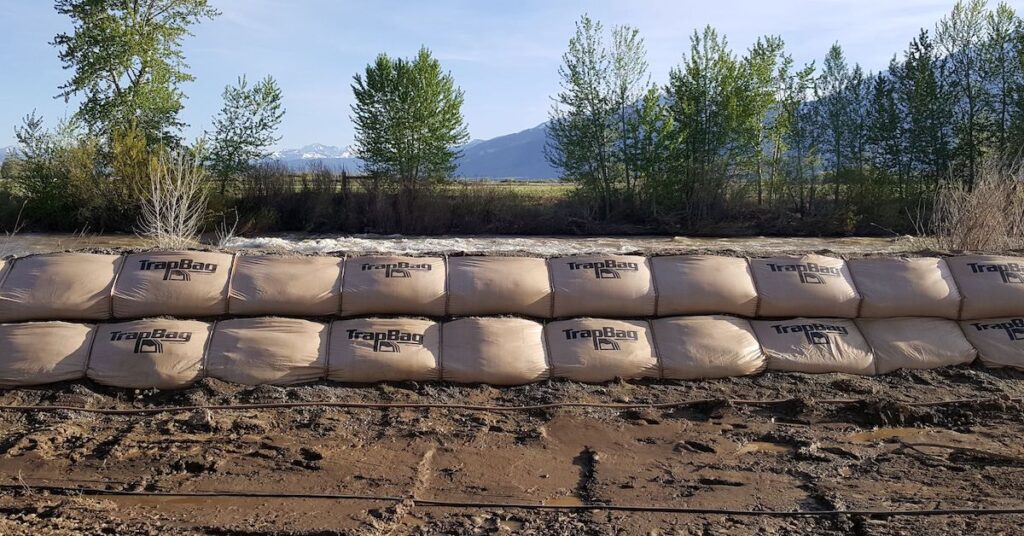
A levee is a constructed wall designed to block water from flooding into areas that need to stay dry, such as roads, farms, and residential areas. The water barrier is typically composed of multiple bags that are filled with sediment, and it prevents the water level from reaching a certain height.
Sandbags are a common strategy for levee construction, but use a lot of material. Our TrapBags® are more reliable and resource-efficient. TrapBags can be filled with sand, washed gravel, or concrete. In the event of flash floods caused by heavy rainfall, TrapBags can be quickly utilized to create a flood protection barrier, such as a levee system.
Temporary Levee System
Natural levee systems, also called temporary levees, are composed of organic materials. They can be made with piles of rocks, soil, or sand, which are low-cost and easily obtained. However, these are not as strong as a permanent levee system due to the porous nature of dirt and other organic materials. The water can sweep away the sediment over time.
Planting grass or other vegetation near the levee helps to anchor the soil and protect the barrier. Containing the sediment with a durable material like TrapBags will make a temporary levee system last longer. Our product has a longevity of five years and creates a flood water barrier that remains durable and strong even if one of the individual bags is compromised.
Permanent Levee System
Permanent levees are part of an infrastructure plan, built using materials like cement, brick walls, or stone walls. Their construction is typically planned by a government or organization. City boards may decide to fund them as a means of flood prevention to protect areas that are high risk. If constructed as a wall, it requires more planning and can’t be achieved on short notice. However, creating permanent levee systems with TrapBag is quick, easy, and convenient. Our strong textile barriers can withhold the strength of cement to create durable levee units.
How Are Levees Built?
A levee is a raised barrier that runs alongside a river, lake, or coast to keep high water from spilling onto the land behind it. Some levees are permanent earthen embankments shaped over weeks or months. Others go up in hours when a flood is already on the way. How a levee gets built depends on the site, the soil, the height of water it has to hold, and how much time crews have before the next surge.
Survey the site and soil
Before any dirt moves, engineers study the ground the levee will sit on. They check soil type, the water table, and how the land slopes toward the channel. Weak or sandy soil under a levee can let water seep through or undermine the base, so the foundation often needs prep work before construction starts.
Shape the embankment
A traditional earthen levee is built up in compacted layers, called lifts. Crews place soil, compact it, and repeat until the levee reaches its design height, with a wide base that tapers toward the top. The slope on each side matters. Build it too steep and it slides; build it too shallow and it wastes land and material.
Add core and armor protection
Many levees include a clay or impermeable core that blocks water from passing straight through the embankment. The outer face often gets armored with riprap, vegetation, or geotextile to handle wave action and runoff. Without that cover, the surface erodes every time the water rises.
Build in drainage and inspection access
Water that collects inside or behind a levee has to drain, so toe drains and relief wells carry it away before it weakens the structure. Crews also leave room to patrol and inspect the levee, since a small leak caught early is far easier to fix than a breach.
Plan for rapid deployment
Permanent levees take time that a community does not always have. When a river is already rising, crews need a barrier that goes up in hours instead of weeks. Rapid-deploy systems fill on site and lock together to form a temporary levee right where the water is headed.
TrapBag dams, dikes, and levees and flood protection barriers give crews that fast option. The pentagon-shaped cells fill with sand or gravel on site, interlock into a continuous wall, and form a working levee far quicker than stacking sandbags or trucking in fill for an earthen berm.
Temporary vs. Permanent Levee: Which Is Better?
TrapBag can be used for temporary and permanent levees. For temporary use, fill with sand or washed gravel; for permanent use, fill with cement. Constructing a cement wall takes significant time, manpower, and effort. An airtight barrier made of TrapBags can be constructed piece by piece. Simply place the bags in the desired area, and fill them with cement through the opening at the top. If you need a higher barrier, repeat the process with a second layer of TrapBags.
The advantage of a permanent levee system is that it doesn’t need to be replaced regularly, and it consists of a one-time cost. A temporary levee system typically consists of cheaper materials, as sand and washed gravel are less expensive than cement. This would be an ideal option for when flood protection is needed for a shorter period of time, due to extreme rainfall or other severe weather conditions. Whatever option you choose, TrapBag can accommodate you.
Levees as a Flood Water Barrier
How Does a Levee System Aid in Flood Prevention?
A levee system is a practical way of creating a flood protection barrier. The most critical step of creating a flood water barrier is to ensure that there are no gaps where water could seep through. TrapBags use a pentagonal design to save time, energy, and money while fitting together seamlessly. The bags are self-contained but connected side-by-side for extra strength. A 100-foot section of 4-foot high TrapBags can replace up to 8,000 sandbags used for flood protection.
The use of levees as a flood protection method is best implemented on the banks of bodies of water, such as rivers, lakes, and basins. If a flood is headed inland, a levee system can be used to create a flood water barrier around the property of a home to minimize damage. It’s important to avoid placing a levee system in areas where it will interfere with underground plumbing, gas lines, or electrical wiring. This applies especially to levees that are reinforced with concrete or other materials built into the ground.
Installation of a levee for flood protection greatly benefits the community as a whole by keeping its land safe from flooding. A collaborative effort to improve the conditions of land and increase safety for all inhabitants is cost effective. Communities coming together to create levee systems and other flood mitigation techniques is crucial during times of disaster. Before building a levee, however, check with your local permit office to see if a permit is required.
TrapBag as a Levee System
TrapBags can be used to build a levee system that stands firm against the forces of water. It performs better than traditional sandbags or earth-made levees that can erode over time. Simply place the bags, insert fill material, and let our product do the work.
How to Fix a Fallen Levee System
Proper maintenance is necessary for flood prevention. Water is a strong force and builds up immense pressure over time, degrading river banks and leaving temporary water barriers vulnerable. Check for damage at regular intervals and make sure the levee is stabilized. A stable structure usually involves a barrier that is wider at the bottom and more narrow at the top.
Our bags are incredibly durable, but if a bag is found to be punctured or otherwise damaged, it should be replaced. In the event of an emergency, rock fill can be used to temporarily reinforce strength behind the levee breach.
State-Federal Levee Flood Prevention
Risk mapping is used by state and federal agencies to determine risk and plan for long-term flood mitigation. Resources are then used to carry out levee system construction projects for flood prevention. Many areas have a levee protection map, and you can view ongoing levee system projects in your geographical location. Flood hazard zones are listed as Zone A or Zone V in the national database and are prioritized for mitigation plans. Locations with significant but less severe flood risk are designated as Zone B, C, or X.
To be labeled as a hazard zone, communities or federal flood prevention programs should certify with the Federal Emergency Management Agency (FEMA). FEMA is a fantastic source for community outreach and disaster prevention education, as well as locating flood maps and guidelines. Levee-protected areas have specific guidelines to follow, adhering to regulations depending on their risk zone.
Protect Your Community with TrapBag
As we witness an increasing number and heightened severity of natural disasters, being prepared is more important than ever.
Floods have a devastating impact on the environment, destroying habitats, spreading toxic chemicals, and causing erosion. They also can cost nearly $5 billion in damage repairs and ruin homes. Protecting the place you love is not a responsibility we take for granted. Our TrapBags have been revolutionary in helping people create flood protection in times of crisis and during natural disasters. Get in touch with us for immediate assistance.
Meet the author

Nick Fasano
Nick Fasano is Business Development Director at TrapBag®, where he oversees operations, growth strategy, and customer success. Since joining in 2018, he has helped lead projects across the U.S. and internationally, including deployments in Florida that protected infrastructure during Hurricanes Ian and Nicole.
Get the Dirt Before the Flood Hits
Stay ahead of flooding, erosion, and disaster response challenges. The Dirt, TrapBag’s monthly newsletter, delivers field-tested tips, real-world case studies, and the latest in barrier technology straight to your inbox.